
Stop fighting your habits, start optimising them!
There is a cup of coffee that means more to me than caffeine.
When my husband is home, he makes it. It is his love language, the quiet ritual of preparation, the intention behind it. And receiving it is mine. That first cup is not just a drink, it is a moment of connection woven into the start of our day. I am not about to give that up. And here is the thing, from a functional nutrition standpoint, I do not have to.
One of the biggest mistakes I see in wellness culture is the obsession with elimination. Cut the coffee, quit the caffeine, white-knuckle your way to a “cleaner” routine.
But that is rarely the most effective strategy, and it almost never sticks.
What works is optimisation.
Working with the habits your body already has, and asking – how do I make this better?
For women moving through perimenopause and menopause, that question becomes especially important. This is a phase of genuine physiological transition, not a dysfunction to be suppressed or a problem to be medicated away, but a shift that the body needs support navigating. Our hormones fluctuate monthly, shift dramatically through life phases, and influence everything from cognition to immunity to energy. The goal is to resource the body intelligently, so it can complete that transition with as much resilience, clarity, and vitality as possible.
So when I realised that the coffee already at the centre of my morning ritual could be quietly upgraded – the same cup, the same warmth, the same ritual my husband hands me, it felt less like a wellness intervention and more like a gift.
THE HORMONAL CASE FOR RETHINKING YOUR MORNING RITUAL
Before we talk about what to add, one foundational principle worth establishing – hydrate before you caffeinate. Cortisol naturally peaks in the first 30 to 60 minutes after waking, and reaching for coffee immediately amplifies that spike, which over time can dysregulate the HPA axis, the system governing stress response, sleep, and hormonal balance. Drinking 300 to 500ml of water with minerals upon rising, followed by a protein-dense breakfast before your first cup, creates measurable downstream effects, particularly for women whose adrenal function is already under pressure during hormonal transition.
My own ritual now looks like this – water first, a proper breakfast, and then – when he is home, that cup appears. The timing has shifted slightly, and the coffee itself has evolved. But the moment, the connection, the meaning of it? That has not changed at all.
Caffeine is not inherently the enemy during perimenopause, but unmediated caffeine can aggravate some of the most common complaints of this phase: disrupted sleep, anxiety, brain fog, and adrenal fatigue. The question is not always whether to drink it, but what you are drinking it with.
This is where adaptogenic mushrooms and botanical extracts become clinically interesting.
THE COFFEE BLEND: WHAT THE EVIDENCE ACTUALLY SAYS
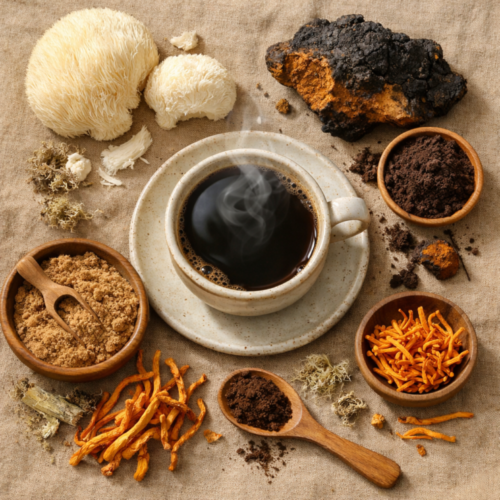
Functional mushrooms have been used in traditional medicine for centuries, but modern extraction methods have significantly increased their bioavailability and therapeutic potency. The blend worth examining contains eight ingredients, each with a distinct and complementary role and all of them arrive in my cup without changing a single thing about the ritual that grounds my mornings.
Lion’s Mane, your cognitive ally – contains compounds shown in research to stimulate Nerve Growth Factor (NGF) synthesis and support BDNF pathways, the proteins essential for the survival and adaptability of brain neurons. During perimenopause, oestrogen decline directly impairs BDNF expression, which is why so many women experience brain fog, word-finding difficulties, and memory lapses. Lion’s Mane works at the cellular level to support the neural environment that oestrogen once helped maintain, making it one of the most clinically relevant mushrooms for this life phase.
Your genetic context: Some women carry a genetic variant (COMT 472 G>A) that means they naturally process dopamine more slowly. In calm conditions, this can actually be an advantage – sharper focus, stronger attention. But as oestrogen declines, this balance shifts and this is where Lion’s Mane becomes particularly valuable, helping maintain the neural environment in which dopamine signalling can stay efficient. If you’d like to know your own variants, you can find out more about the functional DNA test here.
Chaga, the antioxidant powerhouse, has one of the highest antioxidant capacity scores of any natural substance. During hormonal transition, oxidative stress increases, contributing to inflammation, fatigue, and accelerated cellular ageing. Chaga’s betulinic acid and polysaccharide content support immune modulation and help buffer that oxidative load, particularly relevant for women with autoimmune tendencies.
Your genetic context: Some women carry variants in the NRF2 pathway, the body’s master regulator of antioxidant defence, that mean their cells are less efficient at neutralising oxidative stress independently. For these women, the hormonal transition of perimenopause can tip an already stretched system further. Chaga’s dense antioxidant payload helps compensate for this, supporting the cellular resilience that the body may be less able to generate on its own during this life phase.
Cordyceps, your energy regulator and my personal favourite – supports mitochondrial function and cellular oxygen utilisation through activation of the AMPK pathway, our body’s master energy regulator. This is not stimulant energy, it is sustained vitality that comes from cells functioning more efficiently. During perimenopause, declining oestrogen directly affects mitochondrial efficiency, which is why fatigue during this transition often feels qualitatively different from ordinary tiredness. Cordyceps addresses this at the root rather than masking its absence.
And it’s my personal favourite for a reason that goes beyond energy – Cordyceps has a particular affinity for the kidneys, specifically supporting the glomeruli, the tiny filtration units responsible for clearing waste and maintaining fluid balance. It’s where my autoimmune tendency hit me the first time around but I’ll tell you more about it in another blog.
Your genetic context: Some women carry variants in the PPARGC1A gene, which governs mitochondrial biogenesis, essentially the body’s ability to produce new mitochondria, that reduce cellular energy capacity even under optimal conditions. As oestrogen declines and its mitochondrial support withdraws, this genetic tendency can become more pronounced, showing up as persistent fatigue, reduced stamina, and a slower recovery from exertion. Cordyceps directly supports the AMPK-PGC-1α pathway that this gene encodes, making it one of the most targeted nutritional interventions for women navigating this particular intersection of genetics and hormonal change.
Maca root extract, the hormonal harmoniser – works not by supplying hormones but by supporting the hypothalamic-pituitary axis, the body’s own hormonal command centre. Research shows it can reduce hot flushes, improve mood, and restore energy by encouraging the body to regulate itself more efficiently – a meaningful distinction from hormone replacement, and one that makes it particularly relevant during the unpredictable flux of perimenopause, when the command centre is recalibrating rather than shutting down.
Your genetic context: How you experience perimenopause symptoms is partly determined by how efficiently you make and clear oestrogen. CYP17A1 influences production, variants here can affect the hormonal output your body has to work with. CYP1B1, part of the Phase 1 detoxification pathway, determines how that oestrogen is broken down and certain variants push metabolism toward pathways associated with more pronounced symptom expression. Maca supports the system at the point of production and signalling, making it relevant whichever of these variants is creating friction.
Ashwagandha, the stress modulator has demonstrated a clinically significant ability to lower cortisol, support thyroid function, and improve sleep quality – three areas commonly disrupted during perimenopause. For women whose nervous systems are carrying a disproportionate stress load, ashwagandha works quietly and consistently at the root cause.
Your genetic context: Women with the AA variant of COMT 472 G>A are slower to clear stress hormones from the brain, which can contribute to rumination, disrupted sleep, and a stress response that lingers well beyond the original trigger. This tendency becomes more pronounced as oestrogen, which naturally supports COMT activity, declines. Ashwagandha’s HPA axis support is particularly well-matched to this profile.
Rhodiola supports the body’s adaptive response to stress, with clinical evidence for reductions in mental fatigue, improved cognitive performance under pressure, and greater emotional resilience. It does not sedate or stimulate, it helps the system find its own equilibrium. For women navigating perimenopause, this matters considerably. When the nervous system is already managing hormonal flux alongside the demands of daily life, resilience depletes quietly and gradually. Rhodiola restores a steadiness that many women do not realise they have lost until they begin to feel it return.
Your genetic context: Women with the C variant of CYP1A2 A>C are slower caffeine metabolisers, meaning stimulants stay in the system longer and can amplify the anxiety, sleep disruption, and nervous system reactivity that perimenopause already heightens. Rhodiola’s adaptogenic action offers a meaningful counterbalance, helping to maintain calm alertness rather than the wired-but-exhausted state that slow metabolisers are particularly prone to during this life phase.
Inulin powder, the gut axis foundation – a prebiotic fibre, feeds beneficial gut bacteria and supports the oestrobolome — a specialised collection of bacteria that plays a far greater role in hormonal health than most people appreciate. During perimenopause, a compromised oestrobolome can significantly amplify hormonal imbalance by disrupting the clearance and recycling of oestrogen metabolites. Supporting it through consistent daily prebiotic intake is one of the most underutilised yet evidence-informed strategies in hormonal health.
Your genetic context: Women carrying risk variants of MTHFR 677 C>T have a reduced ability to process folate efficiently, which affects methylation, the biochemical process central to oestrogen detoxification. A well-supported gut microbiome helps compensate by optimising the elimination of oestrogen metabolites through the digestive tract, reducing the burden on methylation pathways that may already be working below capacity.
You can find the blend I use here.
THE PRINCIPLE BEHIND THE PRACTICE
What makes this blend genuinely interesting is not any single ingredient, it is the philosophy it represents. Small, consistent, additive interventions that work with the body’s existing rhythms rather than overriding them.
And what it represents in my life is something even simpler – I did not have to sacrifice the habitual ritual that matters to me. The cup my husband makes still arrives. The warmth, the intention, the quiet act of being cared for at the start of a day, all of it intact. Only now, what is inside that cup is working harder for me. Supporting my brain, my energy, my hormonal resilience, my gut, all while I do nothing more disruptive than receive it and drink it.
Perimenopause and menopause are not conditions to be treated, they are transitions to be supported. If your morning coffee is already a fixture of your day, this blend is one of the most low-friction, evidence-informed upgrades you can make to that ritual. Not a replacement, an evolution.
WANT TO GO DEEPER? THE CAPSULE BLEND FOR EXTENDED SUPPORT
For women who want to build on the foundation the coffee provides, there is a complementary capsule formulation worth knowing about. It contains the same core trio of Lion’s Mane, Chaga, and Cordyceps, and adds three further medicinal mushrooms that broaden the therapeutic scope considerably: Maitake, Shiitake, and Reishi.
Reishi’s triterpene compounds have demonstrated anxiolytic and sleep-supportive effects, making it one of the most studied adaptogens for HPA axis regulation. During perimenopause, progesterone, which has a naturally calming effect on the brain, declines alongside oestrogen, leaving many women feeling simultaneously wired, anxious, and unable to achieve restorative sleep. Reishi works at precisely this level, supporting the neurological and endocrine systems as they adapt to a new hormonal landscape.
Maitake’s beta-glucan content has been studied for its role in blood sugar regulation and insulin sensitivity, two things that become noticeably less stable during perimenopause as oestrogen’s influence on glucose metabolism declines. Many women are surprised to find that symptoms they attribute to stress – energy crashes, persistent sugar cravings, new weight distribution around the middle, are partly driven by this metabolic shift. Maitake addresses this directly.
Shiitake contains lentinan with documented immune-modulating properties, alongside eritadenine, which supports healthy cardiovascular function. This distinction between modulation and stimulation is important – Shiitake helps the immune system respond appropriately, which becomes especially relevant post-menopause when oestrogen’s cardioprotective effects diminish.
WHY THESE MUSHROOMS WORK BETTER TOGETHER
The most compelling aspect of these mushroom formulations is not any single ingredient, it is the intelligence of the combinations. They do not simply add their benefits together, they amplify one another through complementary mechanisms.
This is the deeper principle behind the blend – Perimenopause is not a breakdown, it is a transition the body is actively navigating. These mushrooms, working together, are designed to resource that process from multiple directions at once supporting the brain, the nervous system, the mitochondria, the immune response, and the metabolic landscape that shift beneath the surface of every symptom. Not to override the transition, but to meet it, so that the move from one life phase to the next can happen with as much clarity, stability, and resilience as possible and ideally – with a really good cup of coffee in hand.
If you’d like support navigating this transition with a personalised approach, you’re welcome to book a consultation or start with a free 15-minute clarity call.